Shingles rarely announces itself clearly. It often starts as a burning or tingling patch on one side of the chest or back that you put down to a pulled muscle, and only a day or two later does the rash appear.
That delay matters, because antiviral treatment for shingles works best when it starts within 72 hours of the rash appearing. Start it in time and it can take the edge off the pain, shorten the illness and reduce the chance of nerve pain that lingers for months afterwards.
This guide covers how to recognise shingles early, who actually benefits from antivirals, the warning signs that need same-day care, and what to do if you're already past three days. Qrystal Pharmacy is at 301 Borough High Street, a couple of minutes from Borough station, and adults can be assessed here free under NHS Pharmacy First.
What shingles is
If you've had chickenpox, the virus that caused it never fully left. It stays dormant in nerve cells near the spine for years or decades. Shingles happens when it reactivates and travels along one nerve to the skin that nerve supplies.
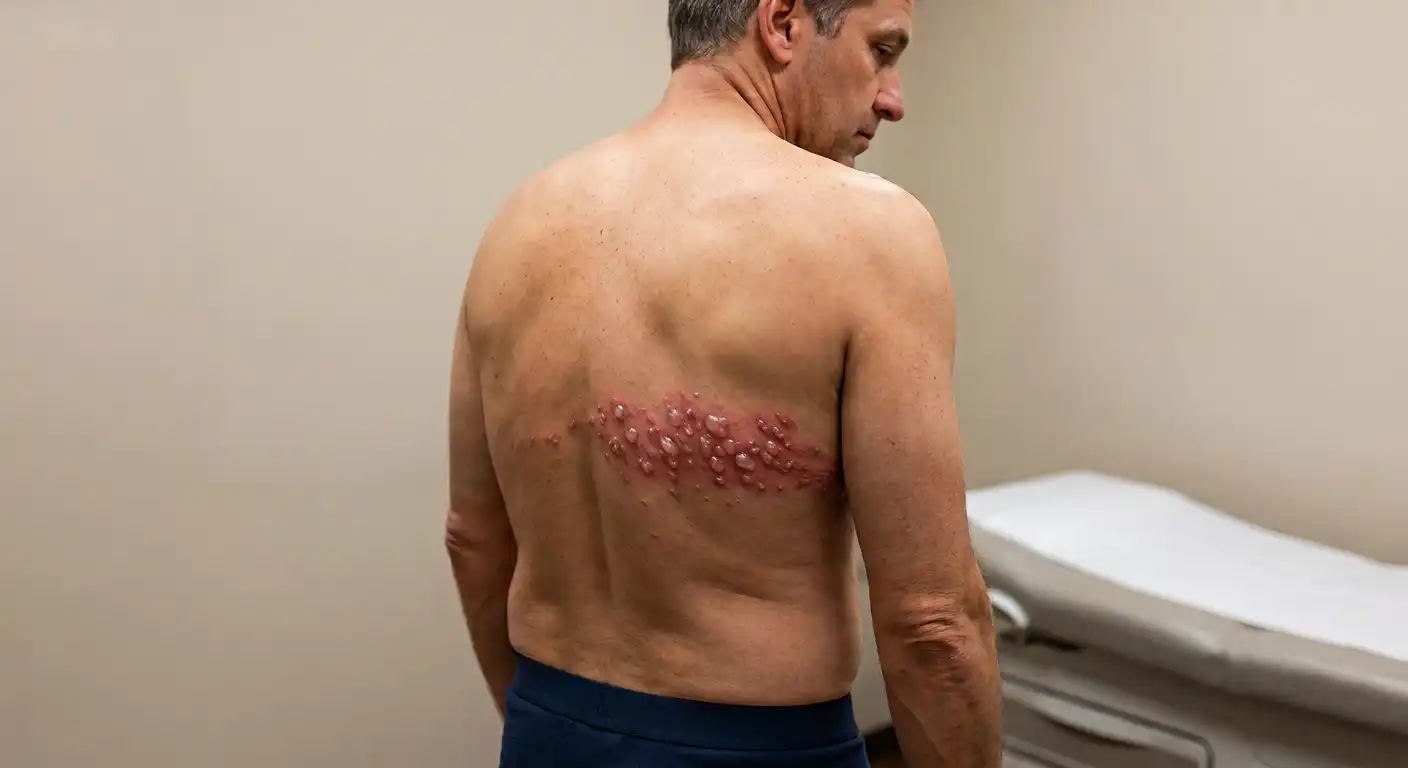
That's why the rash has such a distinctive shape. It follows the territory of a single nerve, so it appears as a band or strip on one side of the body and doesn't usually cross the midline.
Anyone who has had chickenpox can get shingles, and around 1 in 4 people will at some point. It becomes more common after 50, and with anything that weakens the immune system, such as cancer treatment, steroid tablets or some arthritis and bowel medicines. Many people get it with no obvious trigger at all.
How to recognise it early
The first 72 hours are measured from when the rash appears, but the pain usually comes first.
Before the rash (often two to three days):
- Burning, tingling, stabbing or aching in one patch of skin, usually on the chest, back, waist or face
- Skin that feels unusually sensitive to touch or to clothing rubbing
- Sometimes a headache, a high temperature or feeling generally unwell
Once the rash arrives:
- Red blotches on one side of the body in the same area as the pain
- Within a day or so, small fluid-filled blisters in clusters
- The blisters burst and crust over, usually within 7 to 10 days
- The skin can take two to four weeks to heal fully
The single most useful clue is that everything stays on one side. A rash on both sides of the body, or all over, is much less likely to be shingles.
Before the rash, shingles on the chest can feel like heart pain. If you have chest pain with breathlessness or sweating and no rash, don't assume it's shingles: call 999.
Why the first 72 hours matter
Antiviral medicines such as aciclovir and valaciclovir don't kill the virus. They stop it from copying itself, so they make the biggest difference while it is still actively multiplying, which is mostly in the first three days of the rash.
Started in time, they can:
- Reduce the pain of the acute attack
- Help new blisters stop appearing sooner, so the rash heals faster
- Lower the risk of post-herpetic neuralgia (PHN), nerve pain that carries on for three months or more after the rash has healed
PHN becomes more common with age, which is why age is one of the main factors in deciding who gets treated. If a one-sided burning patch is followed by a rash, don't wait to see how it develops.
Does everyone need antivirals?
No. Plenty of people, particularly younger adults with a small, mildly uncomfortable rash on the chest or back, recover just as well without them.
Under the NHS Pharmacy First pathway that came into effect in October 2025, the decision depends on how long ago the rash started and your own circumstances.
If the rash started within the last 72 hours, you're offered treatment if any one of these applies:
- You're over 50
- Your pain is moderate or severe
- The rash is moderate or severe, with blisters merging into larger patches
- The rash is not on your trunk, for example on your neck, arms, legs or genital area
- Your immune system is weakened, by illness or by medicines
If the rash started between three and seven days ago, you can still be treated if any one of these applies:
- You're 70 or over
- You're still getting new blisters
- Your pain is severe
- Your immune system is weakened
- You're at high risk of severe shingles, for example because you have severe eczema
If none of those applies, antivirals are unlikely to help much, and the right plan is pain relief, skin care and knowing when to come back. We'll explain why rather than just sending you away.
Shingles that needs same-day care elsewhere
Most shingles can be managed at the pharmacy. A few places on the body, and a few symptoms, change that.
Get same-day help from your GP, an urgent eye service or NHS 111 if you have:
- A rash on your forehead, scalp near the hairline, nose or around the eye, especially on the tip or side of the nose. This can mean the nerve to the eye is involved, which can threaten your sight
- Eye pain, a red eye, blurred vision or sensitivity to light alongside a shingles rash
- Weakness on one side of the face, or a rash in or around the ear, which can point to Ramsay Hunt syndrome
- A rash that is widespread or appearing in several places
- Shingles while having chemotherapy, after a transplant, or with another condition that seriously weakens your immune system. You may still be treated, but you need a lower threshold for being seen
Call 999 or go to A&E if you or the person you're with has:
- A severe headache, stiff neck or a rash that doesn't fade when pressed with a glass
- Confusion, unusual drowsiness or a change in behaviour
- Weakness in the arms or legs, or loss of bladder or bowel control
- Signs of serious infection: very fast breathing, cold or mottled skin, or feeling extremely unwell
Shingles affecting the eye is the one we most want people not to wait on. If your rash is anywhere on your face, tell the person on the counter as soon as you arrive. Our guide to urgent care near Borough sets out where to go if we're closed.
What happens at the pharmacy
Under Pharmacy First, we can assess shingles in adults who are:
- Aged 18 or over
- Registered with an NHS GP in England
The consultation takes place in our private room. We'll ask when the pain and the rash started, how bad the pain is, what medicines you take, and about any allergies, kidney problems, pregnancy or breastfeeding. With your consent, we'll look at the rash. It usually takes 10 to 15 minutes.
There are three possible outcomes:
- An antiviral, supplied there and then. The first choice is usually aciclovir 800mg five times a day for 7 days. If you have a weakened immune system, already take eight or more medicines a day, or would find five doses a day hard to manage, we may supply valaciclovir 1g three times a day for 7 days instead. Doses can be adjusted if your kidneys don't work as well as they should.
- Self-care and a clear plan, if you don't meet the treatment criteria, with advice on pain relief and when to come back.
- Referral, the same day if needed, if any of the warning signs above apply, or if you're pregnant or breastfeeding and we can't safely supply under the NHS pathway.
The consultation and any medicine supplied under the pathway are free. With your consent, we send a summary to your GP so your records stay complete. Full details are on our shingles treatment page.
Looking after yourself
Whether or not you take an antiviral, the self-care is the same.
- Pain relief. Paracetamol or ibuprofen, if they're suitable for you. If they aren't touching it, tell us or your GP; stronger options are available on prescription.
- Keep the rash clean and dry, in loose cotton clothing. Cool compresses ease the burning; calamine lotion helps the itch.
- Don't burst the blisters or put antibiotic creams on them unless an infection has been diagnosed.
- Cover the rash with clothing or a non-sticky dressing while blisters are weeping.
Come back to us or see your GP if the pain gets worse, the rash spreads, the skin around it becomes hot, swollen or oozes pus, or you develop any of the warning signs above.
Can you pass it on?
You can't catch shingles from someone else, and shingles doesn't spread by coughing or sneezing. But the fluid in the blisters contains live virus, and it can give chickenpox to someone who has never had chickenpox or the vaccine.
Until all the blisters have crusted over, avoid close contact with:
- Pregnant people who haven't had chickenpox
- Newborn and very young babies
- People with a weakened immune system
Don't share towels or clothing in the meantime. You can usually keep working if you feel well enough and the rash can be covered, but if you work in healthcare, childcare or with vulnerable people, check with your employer first.
If the pain doesn't go away
For most people, the pain fades as the rash heals. If it is still there three months after the rash has gone, that is post-herpetic neuralgia. It isn't something to put up with: normal painkillers often don't work well for nerve pain, and your GP can prescribe medicines that do.
The shingles vaccine
The NHS offers a shingles vaccine to older adults and to people with a severely weakened immune system, and it substantially reduces the chance of shingles and of PHN. Eligibility depends on your age and health, so ask your GP practice whether you qualify. Having had shingles doesn't rule you out, though you'll usually be advised to wait until you've recovered. The NHS page on the shingles vaccine has the current details.
If you're getting other vaccines this autumn, our winter health guide for SE1 covers flu and COVID-19.
Shingles in SE1
Borough sits next to one of the country's biggest hospital campuses. Many people around Guy's and London Bridge are having treatment there, including at the cancer centre, or take long-term medicines that dampen the immune system. They are exactly the people at higher risk of severe shingles.
If that's you, keep the 72-hour rule in mind, tell us about your treatment when you come in, and let your specialist team know. Our guide to managing long-term conditions in SE1 covers how we support people on complex medicines.
Shingles is one of seven conditions we treat under Pharmacy First. If another skin problem is on your mind, our guide to impetigo covers the crusty sores that spread through schools, our guide to infected insect bites explains how to tell a normal reaction from an infection, and for a burning feeling of a different kind, see our guide to UTI treatment without a GP appointment.
Getting seen near London Bridge
We're a short walk from most of Borough, London Bridge and Bankside:
- Borough Underground (Northern line): about 2 minutes' walk
- London Bridge (Northern & Jubilee lines, National Rail): about 8 minutes
- Guy's Hospital, Borough Market and Southwark Cathedral: all within about ten minutes
- Buses: frequent routes stop directly outside
Qrystal Pharmacy, 301 Borough High Street, London SE1 1JH. Open Monday to Friday 9:00–18:30 and Saturday 9:00–14:00.
- Walk in: no appointment needed for Pharmacy First
- Call: 020 7403 2237 if you're not sure whether to come in
- Book a consultation if you'd rather hold a slot
If you have a one-sided rash and a burning pain to go with it, don't wait for the weekend to be over or for the rash to get bigger. The sooner you're seen, the more treatment can do.