A bite that swells up overnight, turns red and won't stop itching looks alarming. It is also, almost always, not infected.
Most of what people worry about with insect bites is the body's own reaction: histamine and inflammation doing their job. That reaction doesn't need antibiotics, and they won't make it go away any faster. What antibiotics do treat is the much less common situation where bacteria get into the skin through the bite, and that looks and behaves differently.
This guide explains how to tell the two apart, why the first 48 hours matter, what to do about ticks, the warning signs that need urgent help, and when we can treat you. Qrystal Pharmacy is at 301 Borough High Street, a couple of minutes from Borough station, and adults and children aged 1 and over can be assessed here free under NHS Pharmacy First.
A reaction or an infection?
The normal reaction
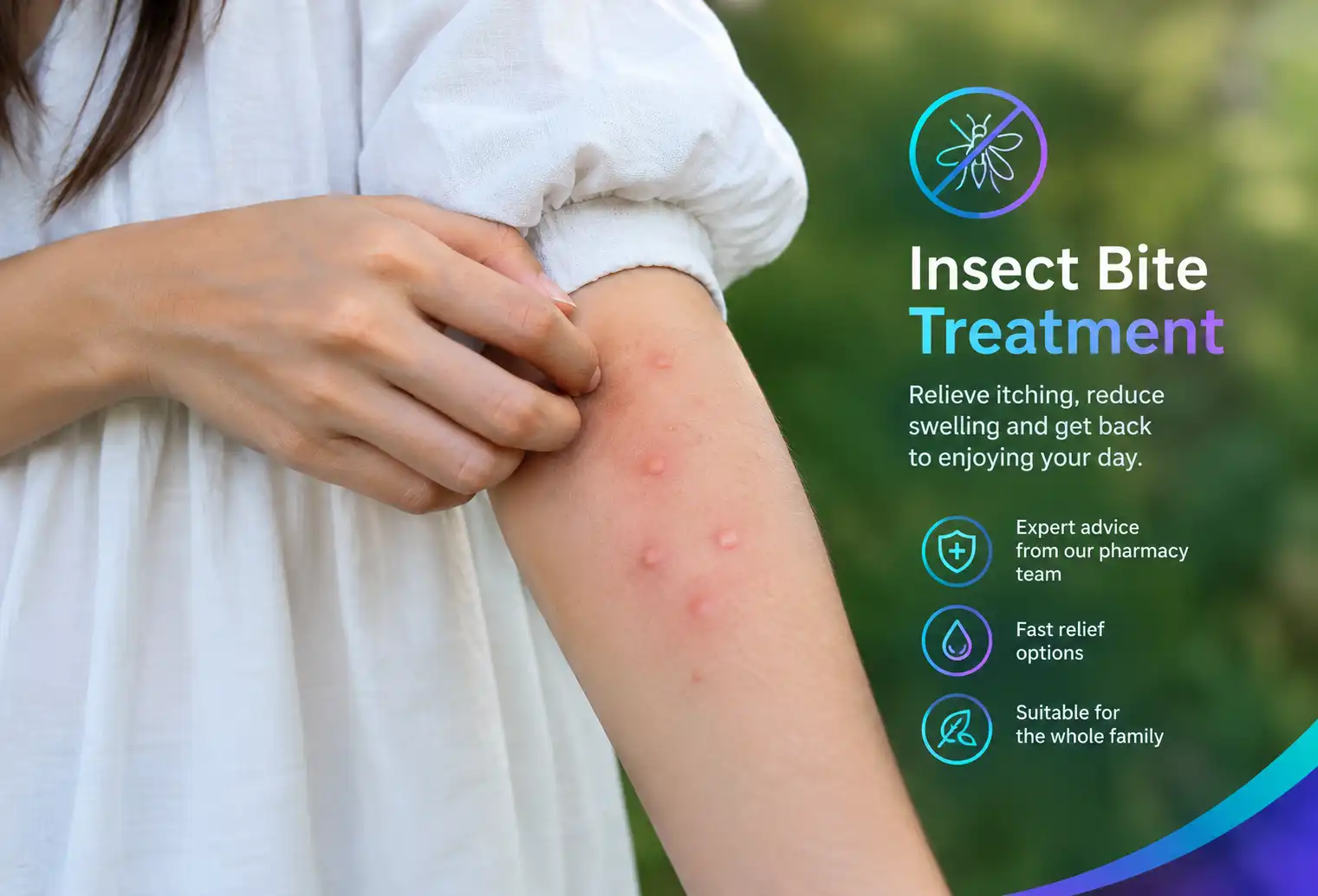
When an insect bites or stings, it leaves saliva or venom in the skin. Your immune system reacts to it, and that reaction is what you see and feel:
- A red, raised lump, sometimes with a small blister in the middle
- Itching, often intense
- Swelling, which can be surprisingly large, especially on the face, hands and ankles, or in children
- Some soreness or a burning feeling, particularly with stings
This reaction comes on quickly, usually within minutes to hours, and peaks within about 48 hours. After that it should slowly settle. Redness and itching can hang around for up to 10 days, which is normal.
Some people have a bigger local reaction, where the swelling spreads 10cm or more around the bite and lasts a few days. It looks dramatic but it's still an allergic-type reaction, not an infection.
The infected bite
Infection happens when bacteria from the skin, usually Staphylococcus or Streptococcus, get in through the bite. Scratching is the usual way in. The tell-tale difference is timing and direction: an infected bite gets worse from around day two onwards, when a reaction should be getting better.
Signs of infection include:
- Redness or swelling that keeps spreading outwards
- Pain or tenderness that's increasing
- Skin around the bite that feels hot
- Pus or a yellowish discharge
- Sometimes a high temperature or swollen glands nearby
On darker skin tones, redness can be harder to see. The area may look darker, purple or shiny instead, so pay more attention to warmth, pain and swelling.
A useful rule of thumb: if the main thing bothering you is the itch, it's very unlikely to be infected. Infection hurts more than it itches.
Why the 48 hours matter
Pharmacists and GPs follow the same principle here, and it's the one in the NHS Pharmacy First pathway: an infection is unlikely to be the cause of symptoms in the first 48 hours after a bite. A bite that's red and swollen the morning after is almost always the reaction.
For antibiotics to be appropriate, the pathway looks for three or more of redness, pain or tenderness, swelling and heat, present or getting worse at least 48 hours after the bite, together with spreading redness or swelling, or pus.
That's not about rationing. Antibiotics for a bite that isn't infected expose you to side effects without any benefit, and contribute to resistance. Our guide to antibiotic resistance explains why that matters to you as well as everyone else.
Draw round it
If you're not sure which way a bite is heading, take a pen and draw a line around the edge of the redness, and note the time. Check it again over the next day:
- Shrinking or staying inside the line: it's settling.
- Spreading past the line: come in and get it looked at.
Take a photo too. It helps whoever assesses it to see how fast it's changed.
What helps a normal reaction
For a bite or sting that isn't infected:
- Remove anything left behind. If a bee sting is still in the skin, scrape it out sideways with a fingernail or bank card rather than squeezing it.
- Wash the area with soap and water.
- Cool it. A cold compress or an ice pack wrapped in a cloth, for around 10 minutes at a time, eases swelling and pain.
- Raise the area if you can, especially for a swollen ankle or hand.
- Don't scratch. Keep nails short, particularly children's. Scratching is how bacteria get in.
- An antihistamine tablet can ease itching and swelling.
- A mild steroid cream such as hydrocortisone reduces the inflammation.
Some antihistamines cause drowsiness, and over-the-counter hydrocortisone isn't suitable for every age or for the face, so ask us which product fits. That advice is free and you don't need an appointment.
Avoid old home remedies like vinegar or bicarbonate of soda; there's no good evidence they help.
Ticks need a different approach
Ticks are tiny spider-like creatures that latch on and feed for days. They live in long grass, woodland and heathland, and are active from spring through autumn, so they're often brought home from a weekend walk, a family trip to the country or a dog walk.
If you find a tick attached:
- Remove it as soon as possible, using fine-tipped tweezers or a tick removal tool.
- Grip it as close to the skin as you can and pull steadily upwards without twisting or squeezing its body.
- Wash the area and apply antiseptic.
- Don't use heat, alcohol or petroleum jelly to make it let go.
In the UK, a small number of ticks carry the bacteria that cause Lyme disease. The sign to watch for is a circular red rash that spreads outwards from the bite, sometimes with a paler centre like a bullseye. It usually appears within one to four weeks, occasionally later, and you may also feel flu-like.
Lyme disease needs a GP rather than a pharmacy, so if you notice that rash, or feel unwell after a tick bite, book a GP appointment and mention the tick. A tick bite with no rash and no symptoms just needs watching.
When it's urgent
Call 999 if, after a bite or sting, someone has:
- Difficulty breathing, wheezing or a tight throat
- Swelling of the lips, tongue, face or throat
- Feels faint, dizzy or confused, or collapses
- Been stung in the mouth or throat
These can be signs of anaphylaxis. If the person has an adrenaline auto-injector, use it straight away, then call 999. Our guide to emergency healthcare near Borough covers where to go for different levels of urgency.
Get same-day help from a GP, NHS 111 or urgent care if:
- A bite near the eye has caused swelling of the eyelid, eye pain, or problems with vision
- Red streaks are spreading from the bite towards the body
- You have a high temperature, shivers or feel generally very unwell
- The redness is spreading very fast
- You have a weakened immune system and the bite looks infected
See a GP rather than a pharmacist for an animal or human bite, a tick bite with a rash or flu-like symptoms, an infected bite after travelling abroad where there's a risk of insect-borne disease such as malaria, or a bite from an unusual or exotic insect. Any fever after visiting a malaria area needs urgent medical assessment, even weeks after you get back.
How Pharmacy First works for an infected bite
Under the NHS Pharmacy First service in England, our pharmacists can assess an infected insect bite or sting in adults and children aged 1 and over. That includes bites from eight-legged creatures such as spiders, mites and ticks, as well as insects. You can walk in, call ahead, or be referred by NHS 111 or your GP practice.
In a private consultation room, the pharmacist will ask when and where you were bitten, how it's changed since, and about your health, medicines and any allergies, then look at the area. There are three possible outcomes:
- A 5-day course of antibiotics, if the bite meets the infection criteria. That's usually flucloxacillin, or clarithromycin if you're allergic to penicillin, or erythromycin if you're pregnant. Start it straight away and finish the course.
- Self-care and a clear plan, if it isn't infected, with advice on the right antihistamine or cream and what would mean coming back.
- Referral, the same day if needed, if any of the warning signs above apply or the bite falls outside the pharmacy pathway.
The consultation and any medicine supplied under the pathway are free. With your consent, we send a summary to your GP so your records stay complete. If it isn't improving by the end of the course, or gets worse at any point, come back or contact your GP. Full details are on our infected insect bite treatment page.
Bites in SE1
Bites aren't only a summer problem round here. Late-season wasps are drawn to the sweet food and drink around Borough Market well into autumn, and stings on hands and lips from a wasp in a drink are a classic. The riverside parks and green spaces from Potters Fields to Southwark Park bring their own share of midges and mosquitoes on warm evenings.
October half-term also brings a wave of bites picked up abroad. If you've just come back from a trip and a bite is getting worse, tell us where you've been. If you're planning the next one, our travel clinic near London Bridge covers bite prevention and malaria tablets before you go.
Infected bites can also lead to other skin infections, especially in children who scratch. Our guide to impetigo explains the crusty, golden sores that can start on a scratched bite. And if you have a painful, one-sided rash rather than a bite, see our guide to shingles and the first 72 hours.
Infected insect bites are one of seven conditions we treat under Pharmacy First.
Getting seen near London Bridge
We're a short walk from most of Borough, London Bridge and Bankside:
- Borough Underground (Northern line): about 2 minutes' walk
- London Bridge (Northern & Jubilee lines, National Rail): about 8 minutes
- Guy's Hospital, Borough Market and Southwark Cathedral: all within about ten minutes
- Buses: frequent routes stop directly outside
Qrystal Pharmacy, 301 Borough High Street, London SE1 1JH. Open Monday to Friday 9:00–18:30 and Saturday 9:00–14:00.
- Walk in: no appointment needed for Pharmacy First
- Call: 020 7403 2237 if you're not sure whether to come in
- Book a consultation if you'd rather hold a slot
Most bites just need patience, a cold compress and a firm word with yourself about scratching. But if yours is getting bigger, hotter and more painful a couple of days on, that's the point to get it looked at.